

Most memberships don’t have a subscription problem, they have a retention problem.
A membership people don’t leave is built through five parts of a sequence, and what I coined as the Architecture of Digital Belonging Blueprint©. It’s the difference between creating a community that loves coming back, and renting an audience you have to bribe to continue to show up.
Before I dive into that, though, I want to make something abundantly clear… most of the groups that get called “communities” online are actually an audience in a really pretty waiting room, with nothing much to do except be sold to. You’ll notice it quickly because basically all the posts come from the brand, the energy comes from the brand, and the responses come from the brand, so when the brand goes quiet, so does everyone else.
You don’t have to be a community marketing strategist to see how that isn’t a community.
The good news is that creating a community doesn’t require luck or charisma. There are mechanics behind building a sense of belonging. The same way a novelist crafts a world a reader wants to live inside through their words– with things like thresholds, rooms, rituals, and rules that hold the universe together– you can build a digital community your members love exploring through engineering systems of belonging.
When time comes to build community, you need to start with your greatest differentiator– the thing that makes you distinctive from others in your industry. Then you can decide on everything that follows.
Why? Because manufacturing attention isn’t difficult.
You can spike your social numbers during a launch using paid ads, you can rent an email list’s eyes for a week using a collab, and you can smile while you watch the graph go up-and-to-the-right. But that attention is rented, and the lease is short. The day you stop paying into it with ad spend, effort, and the exhausting performance of being interesting, the crowd disperses.
It’s a stark reminder that they were never your community to begin with, and it’s a tough lesson to learn that they were just passing through.
Devotion to a community behaves differently.
Devotion doesn’t leave when things are still and quiet for a few days, it doesn’t evaporate when the algorithm shifts or when your new launch period ends, because it was never about the short term. Devotion is about whether a person feels recognized and wanted inside the community you built, because people who feel wanted tend to stick around.
If a person feels seen and respected, they post without being prompted, they bring their friends to join in, and they stay engaged inside the world, not because you posted a clever Tiktok series, but because the community is somewhere they actually want to spend their time.
The industry also agrees with this idea.
The industry has started seeing the same thing. Circle’s 2026 creator research found that 67% of creators still meet their members on social, meaning that discovery lives on TikTok, Instagram, and YouTube, while the revenue increasingly comes from owned platforms, where you control things like access and pricing. 01
🖋️ If you want to know what separates an audience from a community, and how to tell which one you actually have, you can find out more on the blog.
A community, like a paid membership, is a world people choose to explore, so we should design it like one.
To do that, we have to figure out what being in a community really feels like. When I posed this question to myself, I thought about how someone enters, where they spend their time, what makes them feel seen, what holds the structure together when and where they’re not looking, and why they come to visit again. Those five questions, when answered, each solve a specific need for communities:
We design the room before we decorate it. Most people do the opposite: they pick a platform, choose a color palette, post a welcome message, and call it built, then they spend the next year confused about the silence.
That’s why the Architecture of Digital Belonging Blueprint© comes first. It takes each question and breaks it down into a specific state that makes crafting an intentional community as simple as chatting with your followers.
Let’s walk through it.
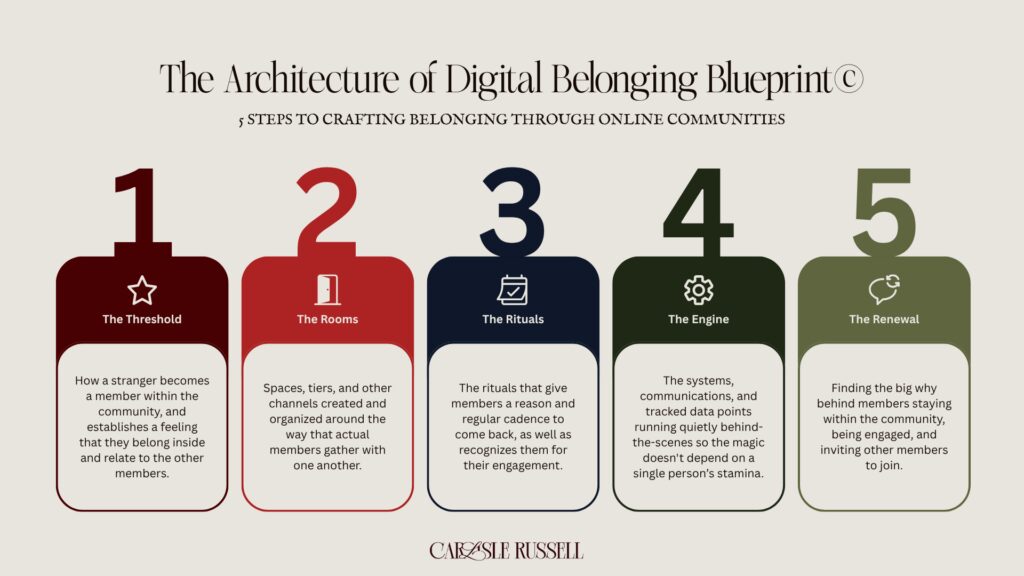
The Threshold is the process that helps a stranger become a member, and it’s often the most overlooked and underbuilt piece of most communities and memberships.
A Threshold, when working properly, should do three things. First, it should tell the new member exactly where they are and what the place they’ve entered is for, including the big promise they get from being active in the community. It should hand them one small win early on, so within their first week they’ve done something rather than just looked at something. And third, it should make the first step towards human contact feel like a conversation that includes a real welcome, their name used, and a question or prompt posed that’s actually achievable.
Here’s a real life example: Someone follows you on Instagram, sees a post you shared about a new community, and decides to join. They believe in what you have to share, so the $10 monthly charge isn’t a problem. However, once they get inside the community, they don’t really know what to do… so, they click around, get lost in the layered spaces, and decide to close it. When they see the charge come through next month, they don’t even bother opening the app– they just email you and ask for help cancelling the subscription.
A person decides whether they belong somewhere in the first few minutes, not the first few months. If those minutes are spent lost in a 1-step onboarding process, reading a generic “Welcome to the community!” banner, and seeing a wall of posts from the brand, the new member quietly exists and forgets that they were excited to join in the first place.
Weak onboarding loses people by making belonging feel like work they have to do alone. Get the Threshold right and most of your retention work is already handled.
The usable move? You can map out the first fourteen to thirty days of a new member’s journey before you build anything else. Consider: what does a member see, do, and feel on day one, day three, day seven, day fourteen? What should they accomplish, or know how to do to succeed in the community? Write it out as a sequence with the goal of helping members complete one win early on that helps prove the space is for them.
🖋️ Onboarding is worth treating as its own discipline; I go in detail in the first 90 days as a membership.
Once a new member has crossed the Threshold, they need somewhere to be. What I call The Rooms are that somewhere, and they are essentially the architecture of the space itself. They include things like the tiers, the groups, the channels, and all the spaces members can go within your community.
It’s half about cognitive load. Too many rooms leading to empty spaces, and the place feels abandoned, like every discussion board is a half-lit hallway nobody’s walking down.
It’s also half about belonging. Too few roms, and there’s nowhere for the specific, smaller conversations that actually create connections.
The art is in matching the rooms to the real social needs inside your world: the place for the whole community, the smaller place for the people deep in one fandom, the place for the quiet members who’d never post in the main feed but will check in somewhere that feels less exposed. The failure pattern is a community where every space ends up running brand-to-member: you to them, you to them, you to them, a hub of brand messages with no soul.
The usable move? Before you add a new space in your membership, think about who it’s for and what would make members gather there. If you can’t name a clear conversation a space is meant to hold, don’t create it.
🖋️ Whether you’re a founder turning an audience into a membership or an author turning readers into a community, the rooms are where the abstract idea of “community” becomes a place with actual conversations.
Members stay because they feel wanted.
Read that twice, because it’s why most community retention budgets get spent in the wrong place.
Brands add another perk, another tier, another piece of content to the membership and wonder why the needle doesn’t move when the thing the member actually needed was to be named, seen, and respected.
Rituals are how you create recognition at scale without it feeling manufactured. A ritual is anything that recurs on a rhythm and makes a member feel like part of something: the weekly thread everyone shows up to debate in, the milestone that gets marked and celebrated by everyone, the anniversary that gets remembered, the member spotlight, the standing event that becomes “the thing we do here.”
The rhythm of the ritual matters as much as the content within it. A community with no cadence is just a feed where things happen, but a community with rituals has a heartbeat because members know what to expect and when to come back.
When this works, the proof is unmistakable and it doesn’t require more work.
In The Armoury, member-led posts ran between 92 and 97% of all posts for ninety straight days, meaning that members were running the place (literally). That’s what rituals do at full strength: they hand the energy of the community back to the community, which is the only place it can live sustainably for the brand.
Recognition is the goal; the ritual is just a reliable way to deliver it.
The usable move? Pick one ritual and make it sacred. One recurring moment, at the same cadence, every single month, until members feel its absence when it’s missing. Then, move on to creating your second, and so on.
The Engine is the unglamorous machinery that makes everything look and feel like magic from the member’s perspective: the automations, the comms, the data, and the operating rhythm humming underneath.
A community held together by one person’s heroics has a shelf life exactly as long as that person’s energy.
You can run on charisma and good intentions for a while, then you get sick, or you launch something, or life happens, or you simply burn out from being the only thing keeping the lights on, and the whole structure sags. Systems outlast launches, and they outlast schedules, and they outlast a well-intentioned founders’ adrenaline.
The work is to move as much as possible from the list of “things I do” to the list of “things that just happen.”
The Engine is also where you finally get to answer the question that quietly destroys community programs if left unanswered: is this actually working?
You can install a simple measurement rhythm, like a handful of numbers watched. Weekly active users. Posts and where they come from. Churn. Event attendance. Enough to see the shape of the thing and catch a problem while it’s still small and quiet.
This matters because a community usually doesn’t break loudly. It goes quiet first, like a slow drift you can feel before you can prove it. With an Engine running, you can see the drift in the data and correct it before members ever feel that the repair is needed.
The Engine isn’t about doing more. It’s about needing to do less for the same, or an improved, result.
The usable move? Build one reporting rhythm and one automation before you build anything fancier. Decide the five numbers you’ll actually want to look at on a regular cadence, set a standing time to look at them, and keep an eye on how things change. Then, automate the single most repetitive thing you currently do by hand (usually the welcome message or a weekly programming reminder).
If the Threshold welcomed members properly, the Rooms gave them somewhere real to be, the Rituals made them feel recognized, and the Engine kept the experience reliable, then renewal stops being a thing you have to sell and starts being the obvious continuation of a relationship they value.
Retention is cheaper than acquisition, and it’s the entire reason a membership beats a launch-to-launch business. A funnel has to refill from zero every time while a membership compounds over time if the members see the value they’ve invested in.
That’s why a higher churn, when it shows up, isn’t mysterious.
Usually it’s something like people who leave early that fell through a weak Threshold, or people who drift away over a couple months when they stopped feeling recognized, or people who leave in a quiet wave that felt the experience became unreliable.
Once you can read churn this way, you stop treating it as a personal rejection and start treating it as a diagnostic.
There’s always a way to correct the real cause behind churn rate increases, and it almost never involves a desperate “we miss you!” email; I walk through it in why members leave, and how to reduce churn.
Here’s what Renewal looks like at full strength in a Membership, again using The Armoury as a case study:
The usable move? Ask your multi-month subscribed members what they like, what they love, and what they’re missing. The replies are your retention strategy, written in their words– build more of whatever they name.
There’s a belief I’d like to take off your plate before it stops you in your tracks: do not think that a real community requires a five-figure custom-built app, a developer on retainer, or a platform with your name etched into the code.
The architecture you create is the asset.
Members rarely know or even care about your construction budget. You can run every one of the five stages of The Architecture of Digital Belonging Blueprint© through platforms you already have access to: a Circle space, a Skool group, a Discord server, a Mighty Networks setup, even a well-designed WhatsApp group chat if that’s genuinely where your people don’t mind gathering.
This matters because the most common reason people never start is a cost requirement standard they created and held themselves to. The thing standing between you and a membership people stay in isn’t a fancy castle (or an app). It’s a thoughtful blueprint, and a blueprint is something you can start creating today.
To be concrete about the difference well-thought-out digital architecture makes, here’s a single picture of all five stages working at once.
The Armoury is a private membership inside Main Character Club Scotland, built for women who want creativity, belonging, and a little bit of magic. Over six months of Community & Membership Management work, with the architecture applied deliberately:
That is what digital architecture does once it’s built and followed. You can read the full Armoury case study here.
What’s the difference between an audience and a community?
An audience consumes what you publish; a community participates in something they feel part of. The clearest test is what happens when you go quiet. An audience goes quiet with you. A community keeps talking, because the energy lives between members, not just between you and them.
How do I build a membership people don’t leave?
Build it in five stages, in order: the Threshold (how a stranger becomes a member and feels they belong), the Rooms (spaces designed around how people actually want to gather), the Rituals (recurring recognition that creates a habit of returning), the Engine (the systems and data that keep it reliable without you), and the Renewal (the reasons members stay and bring others in). Retention is mostly the result of getting the first four stages right.
Why do members leave a membership or community?
Churn is usually a symptom with a stage attached. Early leavers often fell through a weak welcome (a Threshold problem). Members who drift over months usually stopped feeling recognized (a Ritual problem). Sudden waves of churn often follow a stretch where the experience became unreliable (an Engine problem). Diagnosing which one you have is the first step to fixing it.
Do I need an expensive platform or custom build to start a membership
No. The architecture matters far more than the software. The five stages can run on Circle, Skool, Discord, Mighty Networks, or whatever platform already holds your people. You don’t need a castle to build a kingdom, you need a blueprint.
How do I measure whether my community is actually working?
Watch a small, consistent set of numbers rather than a vanity dashboard: weekly active users, where posts are coming from (brand vs. members), churn, and event attendance. The most telling signal is the percentage of activity that’s member-led; when most of what happens comes from members rather than you, the community is healthy.

Rooms We Return To
It's strategy for the culturally-obsessed, written for the people building worlds and the people who love dissecting them.
Rooms We Return To is where I uncover why some worlds earn a permanent place in our lives—and how their creators built them that way. Once a month, I dissect the books, brands, and communities that earn our devotion instead of demanding our attention.
the newsletter
free training
For brands and founders who would rather build a world than chase a trend.
Most online communities are actually audiences. This four-part YouTube video series explores the difference, and how to create a community people genuinely want to join.


